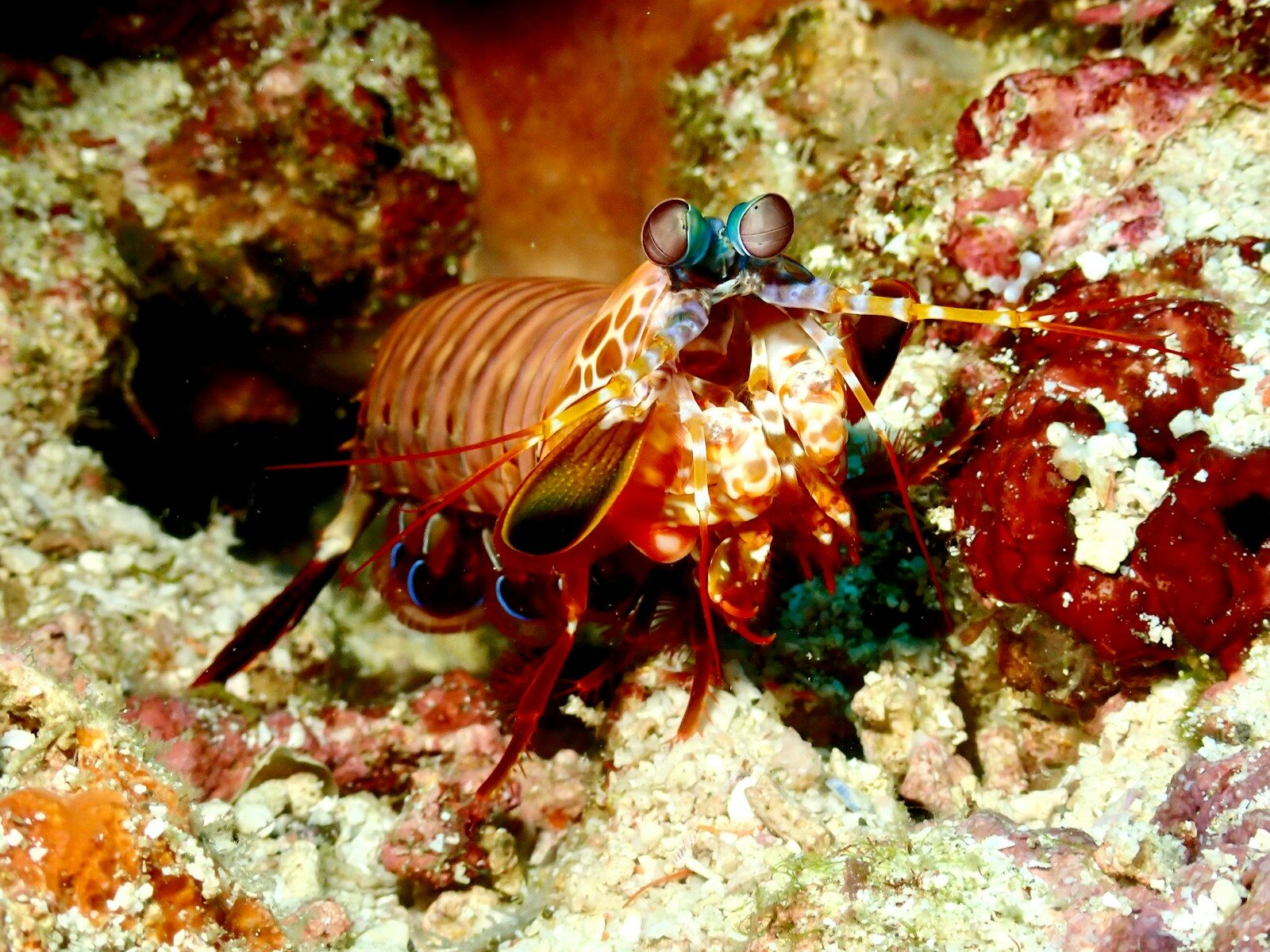
The Mantis Shrimp Punches With the Speed of a .22 Bullet and Sees Colors Humans Can’t Even Imagine — Its Eyes Have 16 Photoreceptors to Our 3
The mantis shrimp might look like a harmless underwater critter, but this stomatopod is actually one of the ocean’s most formidable predators. The mantis shrimp can punch with a force comparable to a .22 caliber bullet, creating speeds of roughly 51 mph and generating 1,500 newtons of force, while its extraordinary eyes possess 16 photoreceptors that allow it to see a color spectrum far beyond human comprehension. For context, humans only have three photoreceptors, limiting our vision to what we consider the full rainbow.
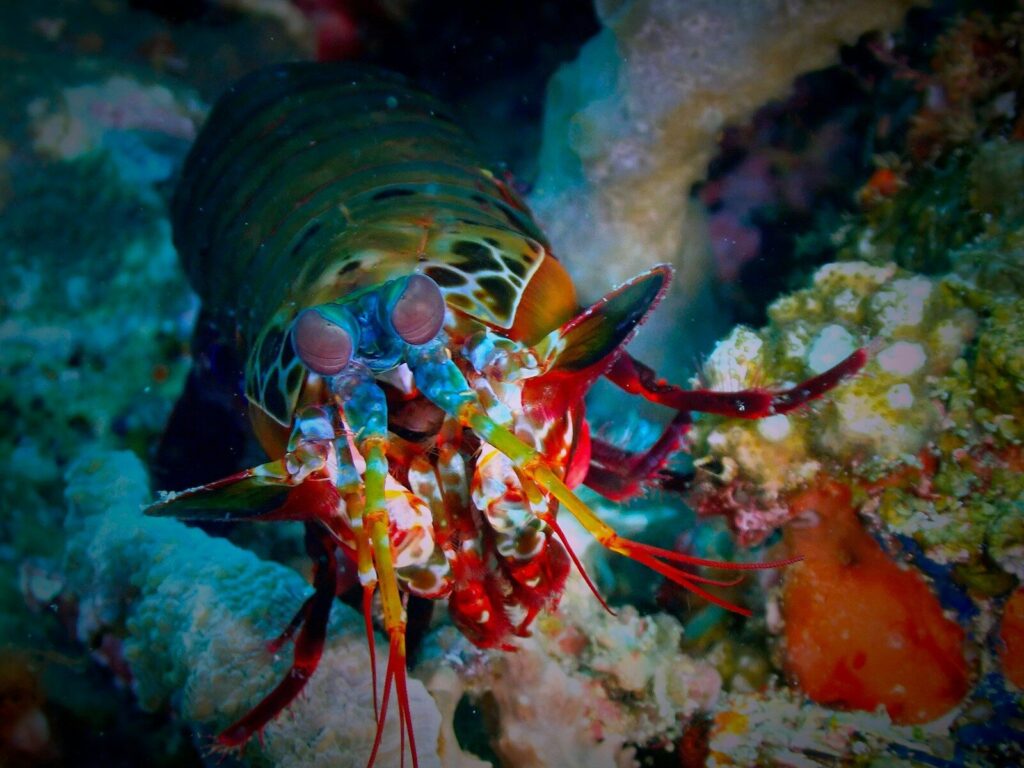
What makes this small marine creature even more fascinating is how it manages these superhuman feats without destroying itself in the process. The mantis shrimp’s specialized club structure absorbs the incredible shock of its own strikes, while its complex visual system processes information in ways scientists are only beginning to understand. This isn’t just about a shrimp with a mean right hook—it’s about evolutionary engineering that’s now inspiring everything from military armor to aerospace materials.
From the intricate mechanics of its devastating punch to the mysteries of its kaleidoscopic vision, the mantis shrimp proves that some of nature’s most impressive innovations come in surprisingly small packages. Understanding how this creature operates reveals insights into physics, biology, and the potential for biomimicry in technological applications that could change how humans design protective equipment.
Unleashing the Bullet Punch: The Mechanics Behind the Strike
The mantis shrimp’s devastating strike combines specialized anatomy with physics-defying mechanics to deliver one of nature’s fastest movements. These crustaceans use a sophisticated spring-loaded system that allows them to accelerate their clubs underwater at speeds that rival firearms.
Power-Amplification in Raptorial Limbs
Mantis shrimp species classified as “smashers” possess highly specialized raptorial appendages designed specifically for delivering devastating blows. The business end of these appendages, called the dactyl club, functions as a hardened hammer that can pulverize prey in milliseconds.
The key to their power lies in their unique anatomical structure. The raptorial limbs contain specialized muscle groups that work differently from typical animal movement. Rather than relying solely on muscle contraction speed, these creatures employ a power-amplification mechanism that stores energy over time and releases it explosively.
Studies published in the Journal of Experimental Biology have documented how this system allows mantis shrimp to generate forces far exceeding what their small muscles could produce through direct contraction alone. The amplification factor can be substantial, multiplying the force output by significant margins compared to conventional muscle-powered strikes.
Spring-Loaded Latch System Explained
The mantis shrimp operates like a tiny biological crossbow. Its muscles contract slowly to compress a saddle-shaped spring structure in the arm segment. A latch mechanism holds this compressed spring in place while energy continues to build.
When the creature releases the latch, the stored elastic energy explodes outward instantaneously. This system separates the energy storage phase from the energy release phase, which is crucial to achieving such extreme velocities. The latch release happens so quickly that it takes only a few milliseconds from trigger to full extension.
This mechanism allows the mantis shrimp to overcome the limitations of muscle contraction speed. Muscles can only contract so fast, but a spring can release energy almost instantaneously once the restraint is removed.
Strike Velocity and Acceleration
The mantis shrimp’s clubs accelerate underwater faster than a .22-caliber bullet, reaching speeds of up to 50 miles per hour in less than 3 milliseconds. This acceleration is particularly remarkable given that water creates approximately 900 times more drag than air.
The strike moves so rapidly that it creates cavitation bubbles in the water. When these bubbles collapse, they generate a secondary shockwave that hits the target immediately after the initial impact. This double-hit effect means prey gets struck twice in rapid succession, even if the club itself misses on the first attempt.
Key Strike Characteristics:
- Peak velocity: 23 meters per second
- Acceleration time: Under 3 milliseconds
- Force generated: Equivalent to hundreds of pounds
The acceleration forces involved would be lethal to most creatures, yet mantis shrimp can deliver thousands of these strikes throughout their lifetime.
Comparisons to a .22 Caliber Bullet
With the force of a .22 caliber bullet, these colorful invertebrates can smash shells and even crack aquarium glass. A .22 caliber bullet travels at approximately 340 meters per second, which is faster in absolute terms, but the comparison highlights the mantis shrimp’s achievement considering its diminutive size.
The bullet punch delivers enough impact energy to shatter the hard shells of mollusks, crabs, and other armored prey. The force concentration at the point of impact creates pressures that exceed the structural limits of most biological materials. Each strike packs enough power to defend territory or kill prey in one fell swoop.
The comparison isn’t just about speed—it’s about the devastating effect. When a mantis shrimp connects with its target, the result is often instantaneous destruction, much like what happens when a bullet impacts a fragile object.
Dactyl Club Design: Nature’s Impact-Resistant Marvel
The mantis shrimp’s dactyl club combines mineralized fibers arranged in herringbone and Bouligand patterns that create a dual-function armor system, while phononic mechanisms selectively filter high-frequency stress waves to protect delicate tissues from the creature’s own devastating strikes.
Layered Patterns and Mineralized Fibers
The dactyl club’s outer surface features mineralized fibers that form the foundation of its incredible toughness. These fibers contain hydroxyapatite, the same mineral found in human bones and teeth, but arranged in a far more sophisticated configuration.
The club’s structure includes two distinct regions that work together. The impact region makes direct contact with prey and is engineered to resist fractures during repeated strikes. Beneath this lies the periodic region, where fibers twist and rotate in layered patterns that filter stress waves.
These mineralized components give the club its hardness while maintaining enough flexibility to absorb energy. The arrangement prevents catastrophic failure even when the shrimp delivers thousands of punches throughout its lifetime.
Bouligand Structure and Herringbone Pattern
The periodic region features a Bouligand structure, where fiber bundles spiral in a corkscrew arrangement. Each layer rotates progressively relative to its neighbors, creating a helical configuration that’s exceptionally resistant to crack propagation.
Combined with this is the herringbone pattern in the impact zone. This V-shaped arrangement of fibers provides additional reinforcement exactly where the club needs it most—at the point of contact.
Key structural elements:
- Bouligand layers: Twisted fiber bundles that redirect stress
- Herringbone reinforcement: V-shaped patterns at impact surface
- Progressive rotation: Each layer offset from the previous one
These patterns inspired impact-resistant materials for aerospace and defense applications, with researchers studying how the geometry influences wave propagation.
Phononic Mechanisms and Sound Filtering
Northwestern University researcher Horacio D. Espinosa and his team discovered that the club’s structure acts as a phononic shield. Unlike previous theories that focused solely on toughness, this mechanism actively filters specific vibrations.
The periodic region selectively blocks high-frequency shear waves that would otherwise damage soft tissues and nerves inside the club. When the shrimp strikes, it creates pressure waves and cavitation bubbles that collapse in the megahertz range.
Using transient grating spectroscopy and picosecond laser ultrasonics, researchers analyzed how stress waves move through the club’s microstructure. They found the corkscrew arrangement governs wave behavior, preventing damaging vibrations from traveling back into the shrimp’s arm.
This represents a shift in materials science understanding. The club doesn’t just absorb impacts—it actively manages which frequencies can pass through its structure.
Self-Protection Against Recoil
The mantis shrimp generates shockwaves powerful enough to crack aquarium glass, yet its own body remains undamaged. This protection comes from the club’s ability to shield delicate biological tissues from recoil forces.
When cavitation bubbles collapse after a strike, they release intense energy bursts. The phononic properties prevent these secondary shockwaves from propagating backward through the club.
The impact region and periodic region work as a system. While the outer herringbone pattern delivers the punch, the inner Bouligand structure filters out destructive vibrations. This dual functionality allows the shrimp to strike repeatedly without accumulating damage.
Researchers at NIST have fabricated synthetic versions of these structures for testing. The biomimicry approach could lead to protective gear that filters blast waves, reducing injuries in military and sports applications.
The Double Whammy: Cavitation and Shockwave Effects
The mantis shrimp’s strike creates two distinct forces that pummel its prey—first from the physical blow of its dactyl club, then from the collapse of cavitation bubbles that form in the water. These cavitation bubbles generate heat, light, and a secondary shockwave that inflicts additional damage on the target.
How Cavitation Bubbles Form
When the mantis shrimp’s dactyl club accelerates through water at speeds reaching 23 meters per second, it creates an extreme low-pressure zone. The water literally can’t move out of the way fast enough.
This rapid displacement drops the water’s density so dramatically that it vaporizes, forming a cavitation bubble between the club and its target. The bubble exists for only microseconds before the surrounding water pressure causes it to violently collapse.
When the bubble implodes, it generates temperatures comparable to the sun’s surface and produces a brief flash of light underwater. This process happens so quickly that all four force peaks—from both clubs striking and both bubbles collapsing—occur in less than 800 microseconds.
Secondary Impact on Prey
The collapsed cavitation bubble delivers what researchers call a secondary shockwave that adds to the destruction already caused by the initial strike. This creates a jack-hammer effect that’s particularly effective at shattering hard prey like snail shells.
Each mantis shrimp has two clubs, so prey actually experiences four separate impacts during a single attack sequence. The pattern goes: first club impact, first cavitation collapse, second club impact, second cavitation collapse.
Peak forces during these strikes can reach 1,500 Newtons—over 2,500 times the animal’s body weight. The combination of physical impact and bubble collapse is what makes the mantis shrimp such a devastatingly effective predator.
Cavitation in Engineering vs. Nature
In human engineering, cavitation is typically a destructive problem that needs solving. Boat propellers get pitted and damaged by cavitation bubbles, sometimes developing holes in the metal from repeated exposure.
The mantis shrimp has essentially weaponized this destructive force. While engineers work to prevent cavitation damage, the mantis shrimp evolved to create and survive it intentionally.
The dactyl club uses a specialized structure to withstand the repeated shockwaves from its own attacks. This natural solution to cavitation resistance has inspired researchers studying next-generation armor materials and protective designs.
Types of Mantis Shrimp: Smashers Versus Spearers
Mantis shrimp species fall into two distinct categories based on their hunting appendages and tactics. Smashers use club-like limbs to pulverize hard-shelled prey, while spearers employ barbed, spiny appendages to impale soft-bodied targets.
Adaptive Hunting Strategies
Smashers and spearers favor different locations for their burrows based on their hunting needs. Spearing species build their habitats in soft sediments where they can ambush fish, shrimp, and other soft-bodied creatures. Smashing species make burrows in hard substrata or coral cavities, positioning themselves near areas rich in crabs, snails, and mollusks.
The hunting approach differs dramatically between the two types. Smashers actively patrol their territory and aggressively attack armored prey, breaking through shells with repeated strikes. Spearers take a more patient approach, lying in wait at the entrance of their burrows and launching lightning-fast attacks when unsuspecting prey ventures too close.
Each strategy reflects adaptation to specific prey types and environments. Smashers need open space to deliver their powerful blows, while spearers rely on the element of surprise from concealed positions.
Weapons: Clubs and Spears
The physical differences between these mantis shrimp types are striking. In spearers, the limbs are spiny with barbed tips designed for piercing prey, resembling the forelegs of praying mantises. These sharp appendages can skewer fish and hold them in place while the shrimp consumes its catch.
Smashers possess heavily reinforced club-like appendages built to withstand enormous impact forces. These dactyl clubs have a layered composite structure that prevents them from shattering despite delivering thousands of high-energy strikes throughout their lifetime.
Key differences include:
- Smashers: Hammer-shaped clubs, blunt force trauma, designed for breaking shells
- Spearers: Sharp barbed spikes, piercing attacks, designed for impaling prey
Both types strike by rapidly unfolding and swinging their claws at prey with incredible speed, though smashers generate significantly higher velocities and impact forces than their spearer cousins.
Famous Species Like the Peacock Mantis Shrimp
The peacock mantis shrimp stands out as one of the most powerful smashing species, known for its rainbow coloration and devastating punch. This species reaches about the size of a human hand but delivers strikes comparable to a .22 caliber bullet impact.
Other notable species include various spearing mantis shrimp that occupy different ecological niches. While smashers like the peacock mantis shrimp get most of the attention for their explosive power, spearers are equally specialized hunters with their own remarkable adaptations.
The diversity among mantis shrimp species reflects millions of years of evolutionary refinement. Each type has perfected its particular hunting method, making them some of the ocean’s most effective predators despite their relatively small size.
Vision Beyond Imagination: The Superpower of 16 Photoreceptors
The mantis shrimp possesses between 12 and 16 photoreceptor types in its compound eyes, allowing it to detect wavelengths from deep ultraviolet to polarized light that humans can’t perceive. This complex visual system represents the most sophisticated color detection mechanism in the animal kingdom.
Structure and Function of Mantis Shrimp Eyes
The mantis shrimp’s compound eyes operate independently of each other, providing near-360-degree vision without moving its body. Each eye contains a specialized band called the midband, which houses the extraordinary collection of photoreceptors stacked in rows.
These photoreceptors enable the creature to see across a spectrum ranging from UV to near-infrared wavelengths. The peacock mantis shrimp and other mantis shrimp species use this visual system to identify prey, communicate with potential mates, and navigate their coral reef environments.
The eyes move independently on stalks, allowing the animal to scan its surroundings with remarkable precision. This setup gives the mantis shrimp depth perception with a single eye, unlike humans who need both eyes working together to judge distances.
Color Perception Versus Humans
Human Vision:
- 3 photoreceptor types (red, green, blue)
- Brain processes combinations to create color perception
- Limited wavelength range
Mantis Shrimp Vision:
- 12-16 photoreceptor types
- Direct wavelength detection
- Extended range including UV and infrared
Interestingly, research shows that despite having more photoreceptors, mantis shrimp actually distinguish fewer color variations than humans. Their visual system prioritizes speed over detailed color processing, allowing them to quickly identify specific wavelengths without the complex neural processing humans require.
Polarized Light and Visual Adaptations
Mantis shrimp detect polarized light, which travels in specific orientations invisible to human eyes. This ability helps them spot transparent prey, recognize other mantis shrimp, and communicate through polarized patterns on their bodies.
The polarization detection works in both linear and circular forms. Circular polarization vision is extremely rare in nature, making the mantis shrimp one of the few animals known to possess this capability.
Scientists believe this visual adaptation evolved to help mantis shrimp species identify each other in complex reef environments where camouflage is common. The technology behind their eyes has inspired researchers developing advanced camera systems and sensors for medical imaging applications.
Innovations From the Ocean: Biomimicry and Human Applications
Scientists have transformed the mantis shrimp’s biological weapons into breakthrough materials that could protect spacecraft from debris and create better body armor. The dactyl club’s unique internal architecture has inspired research into fracture-resistant composites and advanced engineering designs.
Lessons for Armor and Impact-Resistant Materials
The mantis shrimp’s club contains a special arrangement called the bouligand structure, where layers of chitin fibers stack on top of each other like rotating plywood. This natural design prevents cracks from spreading straight through the material.
Researchers at NIST created synthetic versions of these structures using cellulose nanocrystals from plant fibers. They fired microprojectiles at speeds up to 600 meters per second to test how well the materials absorbed impact. The team discovered they could control how energy dissipated by adjusting the thickness and density of the nanocrystals.
Potential applications include:
- Spacecraft shielding against micrometeoroids
- Bullet-resistant glass
- Blast-resistant building materials
- Protective sports helmets
Companies like Helicoid Industries developed commercial composites based on the mantis shrimp’s architecture. These materials show promise for aerospace, defense, and sports equipment.
Phononic Materials and Engineering
The herringbone pattern found in the outer layer of the dactyl club provides additional strength and crack resistance. This geometric arrangement works alongside the bouligand structure to create a remarkably tough composite.
Materials scientist Horacio D. Espinosa and other researchers have studied how these layered structures redirect shock waves. When the club strikes prey, the bouligand arrangement spreads impact forces across multiple layers rather than concentrating stress in one spot.
Biomimicry research on mantis shrimp has led to innovations in materials science that go beyond simple copying. Engineers now understand how to fine-tune mechanical properties by adjusting layer thickness, fiber angles, and material density.
Future Research
Scientists continue exploring how the mantis shrimp’s club withstands thousands of strikes without breaking. The cellular repair mechanisms and self-healing properties of these structures remain active areas of investigation.
Current studies focus on scaling up production of bioinspired materials for commercial use. Researchers are testing different manufacturing techniques to create affordable versions of these advanced composites. The measurement methods developed at NIST can help industry partners develop new impact-resistant materials based on bouligand structures and other natural designs.
Advanced optical sensors represent another frontier, as the mantis shrimp’s complex visual system inspires sophisticated imaging technology for cameras and scientific instruments.