The Aye-Aye Uses Its Extra-Long Middle Finger to Tap Trees and Listen for Insects Inside — Locals in Madagascar Once Killed Them on Sight as Omens
The aye-aye is a long-fingered lemur native to Madagascar with one of nature’s most unusual adaptations: an extraordinarily elongated middle finger used to hunt insects hidden inside trees. This nocturnal primate taps on tree bark with its skeletal third finger and listens for the movement of grubs beneath the surface, then uses the same digit to extract its prey from wood. Despite being the largest nocturnal primate in the world, the aye-aye has faced a darker fate than most endangered species.

For generations, Madagascan folklore portrayed aye-ayes as harbingers of death, with local legends claiming that if one pointed its long finger at someone, it marked them for doom. This superstition led to countless aye-ayes being killed on sight, pushing an already vulnerable species closer to extinction. The same finger that represents millions of years of evolutionary refinement became the source of fear and persecution.
Today, scientists are working to understand this remarkable primate’s unique feeding technique, its place in Madagascar’s ecosystem, and the cultural beliefs that nearly drove it to extinction. From its rodent-like teeth to its behavior of picking its nose with that famous finger, the aye-aye challenges everything people think they know about lemurs and primates.
Meet the Aye-Aye: Madagascar’s Unconventional Nocturnal Primate
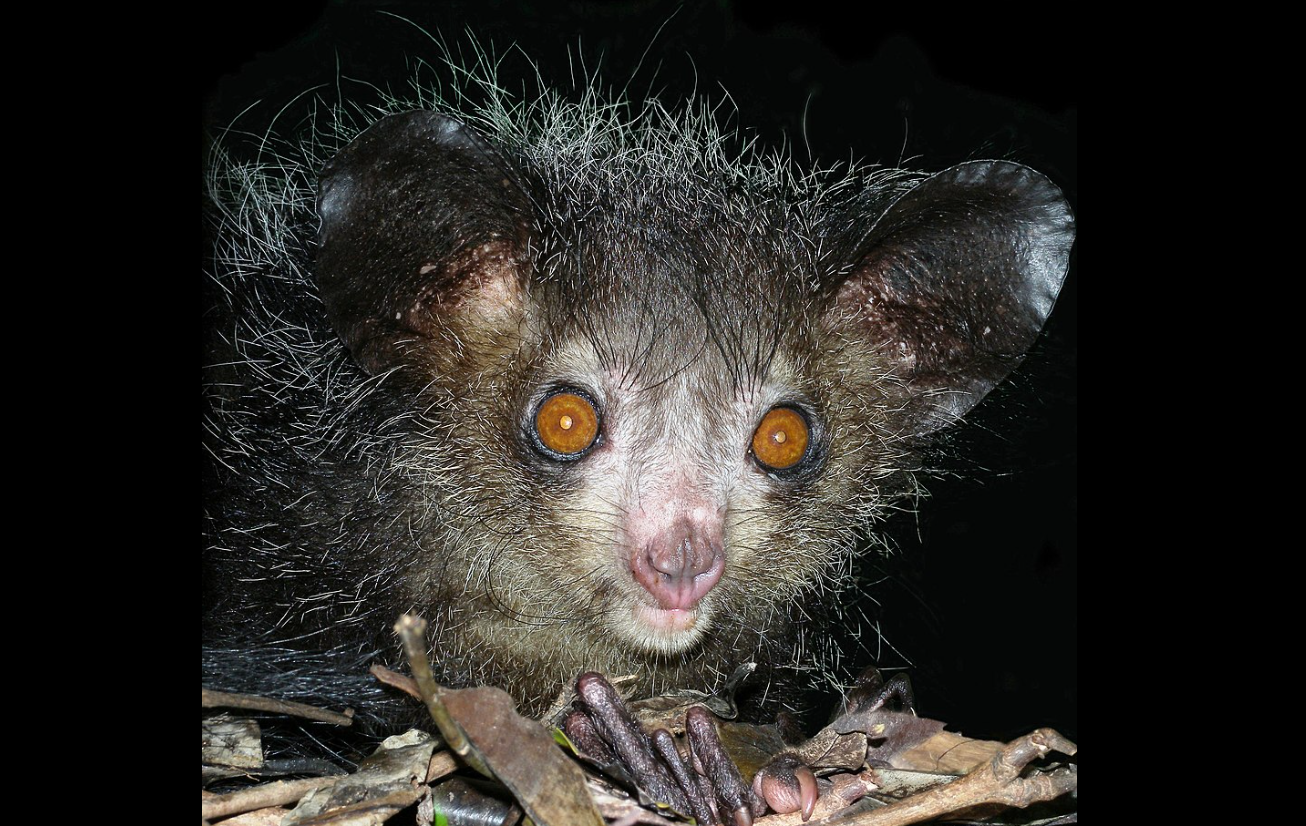
The aye-aye holds the title of the world’s largest nocturnal primate, weighing around 2 kilograms with a body length of about 40 centimeters. This unusual lemur species features continuously growing incisors like a rodent, bat-like ears, and an extremely thin middle finger that makes it stand out among all primates.
What Makes the Aye-Aye Unique Among Lemurs
The aye-aye (Daubentonia madagascariensis) is the only living member of the family Daubentoniidae, setting it apart from other lemur species. Its most distinctive trait is its skeletal-looking middle finger, which possesses a ball-and-socket joint found nowhere else in the animal kingdom.
This specialized digit allows the aye-aye to practice percussive foraging, a hunting technique where it taps on trees at up to eight times per second and listens for hollow chambers containing insects. Once it detects prey, it gnaws through the wood with its rodent-like incisors that never stop growing, then uses that elongated finger to extract grubs and larvae.
The aye-aye fills the ecological niche of a woodpecker in Madagascar’s forests. Scientists have discovered that this primate uses its long middle finger for another surprising purpose—picking its nose and eating the mucus, a behavior called mucophagy.
Physical Features and Anatomy at a Glance
A full-grown aye-aye measures 36-43 centimeters in head and body length, with a tail stretching 56-61 centimeters—longer than its entire body. The animal’s appearance combines features from various mammals, leading to initial confusion about its classification.
Key Physical Characteristics:
- Fur: Thick coat with guard hairs tipped in white on the head and back, while the body displays yellow or brown coloring
- Ears: Extremely large and complex, with ridges that function like a Fresnel lens to focus sound
- Teeth: Continuously growing incisors that slant forward, similar to rodents
- Fingers: Six digits including a pseudothumb for gripping, plus that famous skeletal third finger
- Eyes: Large and adapted for nighttime vision
Young aye-ayes start out silver-colored on their front with a stripe down their back. As these animals reach maturity, their bodies become completely covered in multicolored fur rather than a single solid shade.
Habitat and Arboreal Lifestyle
The aye-aye is an arboreal mammal that spends most of its life high in Madagascar’s trees, rarely descending to the ground. During daylight hours, it sleeps in spherical nests constructed from leaves, branches, and vines tucked into tree forks.
These nocturnal primates emerge after dark to begin foraging, spending up to 80% of the night searching for food in the canopy. They move through the trees by making vertical leaps like squirrels and can travel up to 4 kilometers in a single night.
Aye-ayes are solitary creatures that mark large home ranges with scent. Female territories often overlap with those of several males, while males sometimes share territories and even use the same nests at different times. They’re most commonly found close to the canopy where dense foliage provides plenty of cover from potential threats in nature.
The Legendary Middle Finger: Evolution’s Wild Tool
The aye-aye’s skeletal-thin middle finger can grow up to three times longer than its other digits and features a specialized ball-and-socket joint that enables exceptional mobility for hunting insects hidden inside wood.
Anatomy of the Finger: Ball-and-Socket Powers
The aye-aye’s middle finger is a marvel of specialized evolution that looks almost skeletal in appearance. This extraordinary digit features a specialized ball-and-socket joint at the metacarpophalangeal joint, which allows for incredible range of motion in multiple directions.
The thin middle finger makes up about 65% of the hand’s total length, with the hand itself comprising over 40% of the entire forelimb. This extreme proportion gives the aye-aye remarkable reach when probing inside tree cavities.
The finger’s exceptional thinness allows it to slip into narrow crevices and holes that other primates couldn’t access. It can even reach through the aye-aye’s nose almost to the back of its throat during nose-picking behavior, demonstrating its flexibility.
Flexible Joints and Sensory Skills
The aye-aye combines its specialized finger anatomy with bat-like ears that work together during its unique foraging technique. The primate taps on tree bark to locate hollow spaces where insects are hiding, generating acoustic reverberations that its highly developed ears detect.
This tap-scanning method turns the finger into an active acoustic actuator. The aye-aye listens for subtle changes in sound that indicate grubs and larvae moving beneath the bark.
Once prey is located, the finger extracts wood-boring larvae from inside trees with surgical precision. The combination of auditory feedback and tactile sensing makes this foraging technique remarkably efficient in complete darkness.
Rodent-Like Incisors and Teeth Adaptations
Beyond the finger, the aye-aye sports continuously growing incisors that complement its hunting strategy. These rodent-like teeth gnaw through tough tree bark to access the cavities where insects hide.
The rodent-like incisors never stop growing throughout the animal’s life, similar to rats and squirrels. This dental adaptation allows aye-ayes to chew through wood without wearing down their teeth to useless nubs.
The teeth work in tandem with the specialized finger during feeding. First, the aye-aye uses its incisors to create or enlarge an opening in the wood, then deploys its middle finger to hook out the insects inside.
Percussive Foraging: How Aye-Ayes Tap, Listen, and Feed
The aye-aye has developed a specialized percussive foraging technique that sets it apart from other primates. This hunting method combines tapping, acoustic detection, and precision extraction to locate and capture prey hidden beneath tree bark.
How Echolocation and Hearing Guide the Hunt
The aye-aye relies on its oversized, bat-like ears to detect acoustic cues during foraging. When tapping on wood surfaces, the animal listens for changes in sound that indicate hollow spaces where insect larvae might be hiding.
This process, called tap-scanning, produces dominant frequencies between 6 and 15 kHz. The aye-aye’s auditory system has evolved enhanced sensitivity to these specific frequencies, allowing it to distinguish between solid wood and chambers containing prey.
Unlike true echolocation used by bats or certain fish, the aye-aye taps actively to generate sound rather than emitting vocalizations. The large, mobile ears can rotate independently to pinpoint the exact location of movement beneath the bark. This acoustic hunting strategy resembles techniques used by woodpeckers, though the aye-aye is the only primate to employ this method.
Step-By-Step Through the Foraging Process
The foraging sequence begins when an aye-aye approaches a tree trunk or branch during its nocturnal activity period. It uses its elongated middle finger to tap rapidly on the wood surface while listening intently with its sensitive ears.
Once the aye-aye detects acoustic cues indicating insect movement, it gnaws through the bark with its rodent-like teeth that perpetually grow. The same specialized middle finger then acts like a probe, inserted into the hole to hook and extract grubs or larvae.
The entire process requires patience and precision. Unlike cats stalking prey or other animals that rely primarily on vision, the aye-aye depends almost entirely on acoustic information. After extraction, the insect is consumed immediately before the animal moves to another location on the tree to continue tap-scanning.
Diet: From Insects to Fruit and More
While insects form a significant portion of their diet, aye-ayes are actually omnivorous. They feed heavily on nuts, particularly from Ramy trees, using their teeth to penetrate hard outer shells and their third digit to extract the meat inside.
Their diet includes:
- Wood-boring insect larvae (primary protein source)
- Hard-shelled nuts (Ramy and others)
- Fruit and nectar
- Seeds
- Fungi
The consumption of hard nuts may have actually shaped the aye-aye’s unusual physical features more than insect foraging alone. This dietary flexibility helps maintain the animal’s health throughout seasonal changes when certain food sources become scarce. Unlike specialized feeders that struggle during lean periods, the aye-aye can switch between food types as availability changes.
Superstitions, Folklore, and the Aye-Aye’s Reputation
The aye-aye’s unusual appearance has made it the subject of deeply rooted superstitions across Madagascar, where regional folklore spells disaster for this distinctive primate. These beliefs have historically led to the persecution and killing of aye-ayes by locals who viewed them as harbingers of misfortune.
Cultural Beliefs and Omens in Madagascar
The aye-aye has become fady to the people of Madagascar, a term that roughly translates to taboo or forbidden. This designation stems from the animal’s bizarre physical features, including its skeletal-like middle finger and large, luminous eyes that seem almost supernatural in the dark.
Local legend claims that if an aye-aye points its long finger at a person, it brings misfortune, illness, or death. The creature’s naturally secretive, nocturnal lifestyle only adds to its ominous reputation.
Research has revealed that these traditions stem from beliefs that the aye-aye is inhabited by a spirit, whether evil or ancestral. Some communities even incorporated aye-aye body parts into magical and therapeutic practices. The animal’s fearlessness around humans, unlike other wildlife, may have contributed to the development of these superstitions.
How Myths Led to Persecution
The fear generated by these beliefs resulted in deadly consequences for aye-ayes. When locals encountered these creatures, they often killed them on sight rather than risk the perceived curse. This persecution pushed the already rare species closer to endangerment.
The aye-aye’s unusual anatomies, including its skeletal middle finger, made it look otherworldly to communities unfamiliar with its evolutionary adaptations. Its appearance, combined with its nocturnal habits, created a perfect storm of misunderstanding.
Conservationists faced significant challenges protecting a species that entire communities viewed as evil. Traditional beliefs passed down through generations proved difficult to counter with scientific explanations alone.
Changing Perspectives Through Education and News
Conservation efforts have increasingly focused on reshaping public perception through education and media communications. Researchers have worked to document and understand local beliefs in eastern Madagascar to develop more effective outreach strategies.
Educational programs highlight how the aye-aye’s slender fingers evolved to locate insect larvae, emphasizing its ecological role rather than supernatural associations. News coverage and documentary features have helped showcase the animal’s unique adaptations as evolutionary successes rather than omens.
Some conservation organizations maintain archive materials that demonstrate shifting attitudes over time. By respecting cultural traditions while introducing scientific perspectives, these initiatives aim to reduce killings while acknowledging the deep-rooted nature of fady beliefs.
Conservation Efforts and Threats to Survival
The aye-aye faces serious challenges from habitat destruction due to deforestation and human persecution, though dedicated conservation organizations and breeding programs are working to protect this unusual lemur from extinction.
Habitat Loss and Climate Change
Trees are harvested for construction purposes, removing critical food sources like Intsia bjuga and Canarium madagascariensis whose seeds are dietary staples for aye-ayes. Wood removal for boats, houses, and coffins destroys the forest canopy these nocturnal lemurs depend on for survival.
Madagascar’s ancient forests continue shrinking as human populations expand. The aye-aye requires large territories with mature trees where they can use their specialized middle finger to extract insect larvae from bark. When forests fragment, aye-ayes struggle to find adequate food and safe shelter.
Climate change compounds these problems by altering weather patterns across Madagascar. Shifting rainfall affects the availability of fruits, seeds, and the insects that make up much of the aye-aye’s diet. Temperature changes also impact the timing of flowering and fruiting cycles in trees the species relies upon.
Conservation Organizations in Action
The Durrell Wildlife Conservation Trust has been instrumental in raising awareness about aye-ayes and supporting habitat protection initiatives in Madagascar. They work with local communities to reduce human-wildlife conflict and change negative perceptions rooted in superstition.
Organizations focus on educating villagers about the aye-aye’s ecological importance as pollinators and pest controllers. By demonstrating how these lemurs benefit agricultural areas by eating crop-damaging insects, conservationists are slowly shifting attitudes away from the traditional view of aye-ayes as harbingers of death.
Protection efforts also target the creation of wildlife corridors connecting fragmented forest patches. These corridors allow aye-ayes to move between territories safely, maintaining genetic diversity and access to varied food sources throughout their range.
Captive Breeding and Research at the Duke Lemur Center
The Duke Lemur Center maintains one of the world’s most successful captive breeding programs for aye-ayes outside Madagascar. Their colony provides researchers with opportunities to study behavior, reproduction, and dietary needs that would be nearly impossible to observe in the wild.
Scientists at the facility have made important discoveries about aye-aye communication, cognitive abilities, and foraging techniques. This research informs conservation strategies and helps zoos improve care standards for captive populations. The center also trains Malagasy students and conservationists, building local expertise in lemur biology.
Captive breeding serves as a genetic safety net should wild populations crash. However, reintroduction programs face significant challenges due to ongoing habitat loss and the difficulty of preparing captive-born aye-ayes for survival in Madagascar’s diminished forests.
Aye-Ayes and the Bigger Picture: Science, Evolution, and Beyond
The aye-aye’s peculiar anatomy offers insights into evolutionary adaptation and primate diversity, while its genetic makeup holds potential clues for understanding disease resistance and biological processes that scientists continue to explore.
Evolutionary Niche and Relations to Other Primates
The aye-aye represents a unique evolutionary path among primates. Its closest relatives are lemurs, but the species diverged to fill an ecological niche typically occupied by woodpeckers in other parts of the world. The development of its extraordinarily long middle finger showcases convergent evolution—where unrelated species develop similar traits to solve similar problems.
An aye-aye’s hands make up 41 percent of the length of its forearm. If humans had these proportions, they’d have foot-long hands. The middle finger features a ball-and-socket joint similar to a human shoulder, allowing it to swivel in any direction.
Scientists have identified at least 12 primate species that pick their noses, including humans, capuchins, macaques, chimpanzees, and orangutans. This shared behavior across primate evolution suggests it may serve an unidentified biological function.
Health, Genetics, and Disease
The aye-aye’s genetic makeup offers researchers opportunities to study primate evolution and adaptation. Recent whole-genome scans have examined evidence of positive and balancing selection in wild-caught aye-ayes, enabled by high-quality genomic data and chromosome-level genome annotation.
Research into nose-picking behavior among primates has revealed potential health implications. A 2015 study suggested mucus consumption might protect against cavities, while a 2006 study linked nose-picking to Staphylococcus bacteria that can cause staph infections. In most cases, these bacteria produce no symptoms or only mild skin issues.
The genetic study of aye-ayes contributes to broader understanding of primate biology, though specific connections to human diseases like flu or HIV haven’t been established through aye-aye research specifically.
Curious Comparisons: Space, NASA, and Mars?
While aye-ayes don’t have direct connections to space exploration or NASA missions, their specialized adaptations inspire biomimetic engineering approaches. The tap-scanning technique they use—tapping bark and listening for hollow cavities—resembles sonar and ultrasonic detection methods used in various technological applications.
Their skeletal middle finger functions like a probe, extracting resources from hard-to-reach places. This principle mirrors robotic arms and exploration tools designed for environments where precision matters, though no specific Mars rover or NASA technology has been directly modeled after aye-aye anatomy.