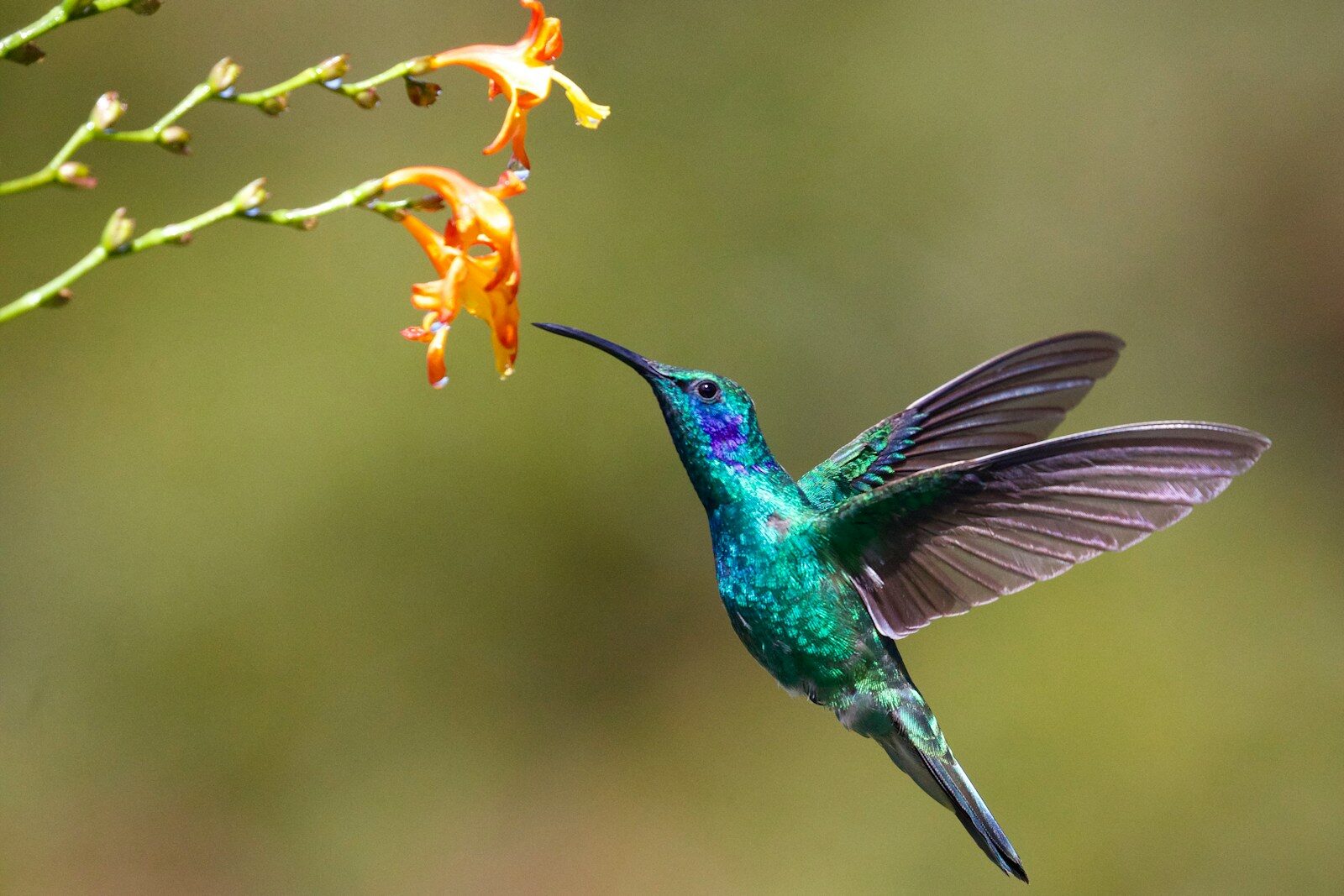
A Hummingbird’s Heart Beats Up to 1,260 Times a Minute and Its Wings Flap 80 Times a Second — It Has to Eat Every 10–15 Minutes to Stay Alive
Hummingbirds are among the most extraordinary creatures in the animal kingdom, pushing the limits of what seems physically possible for their tiny bodies. A hummingbird’s heart beats up to 1,260 times per minute during flight, while its wings flap around 80 times per second, creating metabolic demands so intense that these birds must feed every 10 to 15 minutes just to survive. These aren’t just interesting numbers—they represent one of nature’s most extreme examples of biological engineering.

What makes these birds so fascinating isn’t just their speed, but how every part of their anatomy has evolved to support their high-energy lifestyle. From hearts that take up 2.5% of their body weight to specialized muscle cells packed with energy-producing mitochondria, hummingbirds are essentially flying metabolic furnaces. Their heart rate can reach 1,260 beats per minute while their wings generate lift on both the upstroke and downstroke—a feat no other bird can replicate.
The real surprise comes when looking at how these birds balance their extreme energy expenditure with survival strategies that seem almost contradictory. While they maintain some of the highest metabolic rates in the animal world during the day, hummingbirds enter a state called torpor at night, dramatically slowing their systems to conserve precious energy reserves. Understanding these remarkable adaptations reveals just how hummingbird facts challenge our assumptions about what’s possible in nature.
The High-Speed Hummingbird Heart
A hummingbird’s cardiovascular system operates at rates that dwarf those of nearly every other creature on Earth. The hummingbird heart beats between 500 and 1,260 times per minute depending on activity level, while the bird maintains one of the highest mass-specific metabolic rates in the animal kingdom.
How Fast Does a Hummingbird’s Heart Beat?
The hummingbird heart rate ranges from 500 to 1,200 beats per minute during typical activity. When these birds really push themselves during flight, their hearts can reach up to 1,260 beats per minute.
A Costa’s hummingbird’s heart beats between 500 and 900 times each minute while resting. During torpor, a hibernation-like state that helps conserve energy on cold nights, the heart rate drops dramatically to as low as 50 beats per minute.
The hummingbird heart accounts for 2.5 percent of total body weight, making it the largest heart relative to body size in the entire animal kingdom. This massive cardiovascular organ powers the bird’s extreme energy demands throughout the day.
Heart Rate vs. Other Birds and Animals
Humans have a resting heart rate around 72 beats per minute, making the hummingbird cardiovascular system roughly 7 to 17 times faster than our own. The human heart accounts for only 0.3 percent of body mass, a fraction of the hummingbird’s proportional heart size.
Other birds don’t come close to matching these rates. Even the most active songbirds and raptors maintain heart rates in the low hundreds during flight. The hummingbird’s wings beat up to 80 times per second, requiring constant oxygen delivery that only an ultra-fast heart can provide.
The Role of Heart Rate in Survival
The extreme bird heart rate serves a critical function in hummingbird survival. These rapid wing beats require extraordinary amounts of oxygen and nutrients, which the high heart rate delivers through constant blood flow to flight muscles.
Flight muscles make up 25 to 30 percent of a hummingbird’s body mass. These muscles need instant fuel access to maintain hovering, backward flight, and rapid direction changes. Without the rapid heartbeat pumping oxygenated blood continuously, the bird couldn’t sustain its aerial abilities.
The cardiovascular system works overtime to support the fastest metabolism in the animal kingdom. This is why hummingbirds must feed every 10 to 15 minutes during waking hours, consuming up to three times their body weight in nectar daily to keep their high-performance hearts running.
Incredible Hummingbird Flight Skills
Hummingbirds possess flight capabilities that set them apart from every other bird species, with specialized wings that enable movements impossible for most avian creatures. Their wings beat anywhere from 50 to 80 times per second during regular flight, powering maneuvers that seem to defy the laws of physics.
Hovering Flight and Wing Mechanics
The hummingbird’s ability to hover in place represents one of nature’s most impressive engineering feats. Unlike other birds that generate lift only on the downstroke, hummingbird wings rotate at the shoulder in a figure-eight pattern that produces lift on both the upstroke and downstroke.
This unique wing structure allows them to remain perfectly still in mid-air while feeding from flowers. The wings connect to the body only at the shoulder joint, giving them exceptional rotational flexibility.
A hovering hummingbird’s heart can beat over 1,200 times per minute—about 20 beats per second—to pump oxygen-rich blood to their power-hungry flight muscles. Their flight muscles make up 25-30% of their total body weight, a higher percentage than almost any other bird species.
Wingbeat Frequencies by Species
Wingbeat frequency varies significantly across different hummingbird species depending on their size and flight needs. Ruby-throated hummingbirds flap their wings at a rate of 50 times per second, while smaller species beat their wings even faster.
Typical Wingbeat Ranges:
- Normal flight: 50-80 beats per second
- Hovering: 80 beats per second
- Courtship dives: Up to 200 beats per second
Larger hummingbird species tend to have slower wingbeat frequencies than their smaller cousins. The smallest species require faster wing beats to generate enough lift to support their rapid metabolism and maintain their characteristic flight patterns.
Backward and Upside Down Flight
Hummingbirds are the only birds capable of sustained backward flight, a skill that comes from their unique wing anatomy. They can fly in any direction—forward, backward, sideways, up, and down—with remarkable precision and control.
During courtship displays, males perform incredible aerial acrobatics that include flying upside down and executing rapid directional changes. These maneuvers require instantaneous adjustments to wing angle and beat frequency.
Their ability to reverse direction instantly makes them exceptionally agile hunters of small insects and allows them to escape predators with ease. Some species can achieve velocities of 90 feet per second in flight, reaching speeds of 20-30 mph during regular travel between feeding sites.
Tiny Birds, Enormous Appetites: Hummingbird Metabolism
Hummingbirds possess one of the most extreme metabolisms in the animal kingdom, burning energy at rates that dwarf nearly every other vertebrate. Their metabolism operates 77 times faster than a human’s, allowing them to process massive amounts of sugar while maintaining blood glucose levels that would be fatal to people.
Feeding Frequency and Energy Needs
A hummingbird’s energy demands are staggering. These birds need to consume approximately half their body weight in sugar daily just to survive.
They require the equivalent of over 150,000 human calories each day to sustain their rapid flight and bodily functions. This means they must visit hundreds of flowers from sunrise to sunset, sipping nectar almost constantly.
Hummingbirds look for resting spots every 10-15 minutes because the constant wing-beating and flight exhaust them quickly. Without this frequent feeding schedule, they would run out of energy and die within hours.
Different hummingbird species have slightly varying energy requirements, but all share this same need for constant food intake. Their mass-specific metabolic rate far exceeds that of any mammal, making them true metabolic marvels.
How Hummingbirds Digest Food So Fast
Hummingbirds have evolved specialized enzymes in their liver and muscles that break down sugars with remarkable efficiency. These supercharged enzymes allow them to process fuel sources at speeds other vertebrates cannot match.
The birds can switch between burning sugar and burning fat in mere minutes, a metabolic flexibility that’s far faster than other organisms can manage. Much of the sugar they consume goes directly to their flight muscles rather than being stored.
Their liver processes excess sugar into fat that fuels long-distance migration. When migrating, hummingbirds can double their body weight in just days, then burn through those fat stores at incredible rates during their journey.
Despite consuming dangerous amounts of sugar by human standards, hummingbirds show no signs of diabetes or metabolic disease.
Unique Adaptations of Hummingbird Anatomy
Hummingbirds possess specialized anatomical features that enable their demanding lifestyle, from hearts that pump at extraordinary rates to muscles optimized for continuous rapid movement. These adaptations work together to support the extreme metabolic needs of these tiny birds.
The Proportionally Large Hummingbird Heart
The hummingbird heart represents one of nature’s most impressive cardiovascular adaptations. This organ accounts for a substantial portion of the bird’s body mass, far exceeding the heart-to-body ratio found in most other animals.
A hummingbird’s heart beats up to 1,260 times per minute during flight, making it one of the fastest heart rates observed in any endotherm. At rest, the heart rate drops to around 250 beats per minute, though this is still remarkably high compared to other birds.
Recent research reveals that hummingbird hearts contain ventricular cells that are 8-fold smaller than those in mice, with a cell density approximately 7 times greater. The cells measure just 41 μm² in cross-sectional area, allowing for more rapid electrical signaling and contraction cycles that support their extreme heart rates.
Capillary Networks and Oxygen Delivery
Dense capillary networks throughout the hummingbird’s body ensure efficient oxygen delivery to meet intense metabolic demands. The cardiovascular system must rapidly transport nutrients and oxygen to sustain continuous hovering and rapid flight.
Studies show that hummingbird hearts have 18 capillaries per 2,500 μm², significantly higher than most mammals. This elevated capillary density allows for faster diffusion of oxygen and nutrients into tissues while simultaneously removing metabolic waste products.
The extensive capillary networks work in tandem with the rapid heart rate to maintain blood flow even during the most energetically expensive activities. This adaptation proves essential for sustaining the hovering flight that characterizes these birds.
Specialized Muscles for Rapid Movement
Flight muscles make up 25 to 30 percent of a hummingbird’s total body mass, a proportion rarely seen in other bird species. These powerful muscles enable the distinctive figure-eight wing pattern that generates lift on both upstrokes and downstrokes.
During normal flight, hummingbird wings beat approximately 80 times per second. The wing beat frequency can increase dramatically during courtship displays, reaching up to 200 times per second during dives.
The shoulder joint allows for unique rotational movement not found in most birds. This specialized joint structure enables the wings to rotate nearly 180 degrees, creating lift throughout the entire wingbeat cycle rather than just on the downstroke.
Energy Saving Strategies: Torpor and the Nighttime Slowdown
A hummingbird’s body temperature can plummet by 50 degrees Fahrenheit at night, and its heart rate drops from over 1,000 beats per minute to as low as 50. This dramatic physiological shift allows these tiny birds to survive the night without their constant need to refuel.
What Is Torpor in Hummingbirds?
Torpor is a state of decreased physiological activity that hummingbirds enter to conserve energy, primarily at night when they cannot feed. Unlike regular sleep, torpor involves shutting down most bodily functions to an extreme degree.
During torpor, a hummingbird’s body temperature drops from around 105°F to as low as 50°F depending on environmental conditions. The bird’s metabolic rate can slow down by up to 95%, allowing it to conserve the massive amounts of energy it burns during the day.
Research has revealed that hummingbirds actually use different levels of torpor: shallow and deep. Smaller hummingbirds tend to use deep torpor every night, while larger species sometimes use shallow torpor or skip it entirely. In shallow torpor, body temperature drops by about 20 degrees, while deep torpor reduces it by 50 degrees below normal daytime levels.
The warming-up process can take up to 30 minutes. During deep torpor, hummingbirds become more vulnerable to predators and their immune systems shut down, which is why some birds use the less extreme shallow torpor to balance energy savings with these risks.
How Heart Rate Changes During Torpor
The hummingbird heart undergoes one of the most extreme rate changes in the animal kingdom between active and rest states. During the day, a hummingbird’s heart beats around 1,200 times per minute, but in torpor, it slows to as little as 50 beats per minute.
This represents a 96% reduction in heart rate. The hummingbird heart essentially shifts from frantic overdrive to barely ticking over. Their respiration also drops dramatically during this state, slowing to just 1-3 breaths per minute.
These changes work together to create extreme energy conservation. Without the ability to enter torpor and slow their heart rate so dramatically, hummingbirds would likely starve to death overnight since they cannot eat in the dark. It’s one of the most fascinating hummingbird facts that sets them apart from most other birds.
Hummingbird Species Highlights and Fun Facts
The hummingbird family includes roughly 375 species ranging from the tiny bee hummingbird to larger varieties, each with unique characteristics in size, behavior, and habitat. Some species like the ruby-throated and rufous hummingbirds are particularly well-known across North America, while baby hummingbirds grow at remarkable rates despite their minuscule starting size.
The Smallest Bird: Bee Hummingbird
The bee hummingbird holds the title as the smallest bird in the world, measuring just 2 to 2.4 inches in length and weighing less than a penny. Found exclusively in Cuba, this tiny species is so small that it’s often mistaken for an insect when spotted in the wild.
Male bee hummingbirds are slightly smaller than females and display brilliant iridescent red and blue plumage during breeding season. Despite their diminutive size, they still maintain the same high-energy lifestyle as their larger relatives, requiring constant feeding to fuel their rapid metabolism.
Their nests are equally miniature, often no bigger than a thimble, with eggs roughly the size of a coffee bean. The bee hummingbird’s small stature doesn’t limit its territorial nature, as males vigorously defend feeding areas from intruders.
Notable Species: Ruby-Throated and Rufous Hummingbirds
The ruby-throated hummingbird is the most common species in eastern North America, easily recognized by the male’s vibrant red throat patch. Ruby-throated hummingbirds’ wings beat about 70 times per second during normal flight and more than 200 times per second while diving.
These birds undertake an impressive migration, traveling up to 500 miles non-stop across the Gulf of Mexico. They build up significant fat reserves before migration, gaining 25-40% of their body weight to fuel the journey.
The rufous hummingbird, sporting bright orange-red plumage, has one of the longest migration routes of any hummingbird species. They travel from Alaska to Mexico, covering over 3,000 miles each way. Rufous hummingbirds are particularly aggressive despite their small size, often dominating feeders and chasing away larger hummingbird species.
Baby Hummingbirds and Growth
Baby hummingbirds, called chicks, hatch from eggs about the size of a jellybean after 14-23 days of incubation. They’re born blind, nearly featherless, and completely dependent on their mother for warmth and food.
The mother feeds her chicks by inserting her bill into their mouths and regurgitating a mixture of nectar and small insects. Chicks grow rapidly, doubling their weight within the first few days and developing feathers within a week.
Young hummingbirds remain in the nest for approximately three weeks before fledging. Even after leaving the nest, they continue to be fed by their mother for another week or two while learning to feed themselves. By the time they’re fully independent, they’ve developed the same incredible flying abilities and metabolic demands as adult hummingbirds.